7 Advantages of Thermo Pine Cladding and Decking
Thermo Pine is a thermally modified pine timber used in selected architectural cladding and decking applications. Its natural wood grain, warm appearance and modified material properties make it an option for contemporary residential and commercial projects.
At Lux Line Co, we help architects, interior designers, builders, developers and homeowners explore timber cladding and decking solutions for their projects in Hyderabad and surrounding areas.
Whether you are planning a villa facade, an outdoor deck, a garden feature or a contemporary architectural space, understanding the benefits and limitations of Thermo Pine can help you make an informed material choice.
Here are seven important advantages to consider before specifying Thermo Pine cladding or decking.
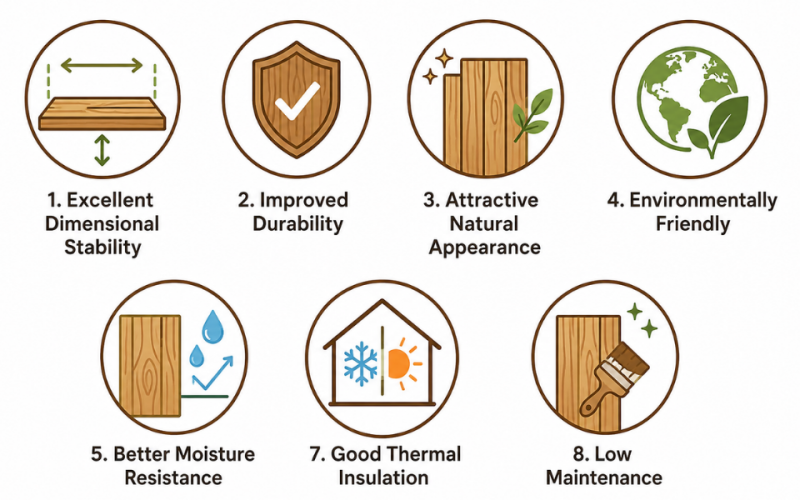
1. Improved Dimensional Stability
Natural timber can expand, contract or change shape as its moisture content changes. Thermal modification alters the properties of wood and can improve its dimensional stability compared with untreated timber.
For cladding and decking projects, this can help reduce moisture-related movement when the timber is correctly specified and installed.
Key benefits:
Reduced moisture-related movement compared with untreated pine.
Greater dimensional stability, depending on the treatment.
Potentially less distortion when installation requirements are followed.
A consistent natural timber appearance.
A suitable option for selected architectural applications.
Correct storage, acclimatisation where required, ventilation, drainage and fixing methods remain important. Thermo Pine should not be considered immune to movement, checking or cracking.
2. Improved Resistance to Biological Decay
Thermal modification changes the chemical composition of wood and can improve its resistance to certain forms of fungal decay. The level of improvement depends on the treatment process and the resulting product specification.
This makes appropriately treated Thermo Pine worth considering for specified exterior applications.
Key benefits:
Improved resistance to certain types of fungal decay.
Modified timber properties compared with untreated pine.
Potential suitability for selected exterior cladding applications.
Natural timber character for architectural projects.
Performance that can be supported by correct installation and maintenance.
Check the supplier’s technical documentation for the durability classification and intended use. Thermal modification does not automatically make timber suitable for ground contact or every permanently wet environment.
3. Natural Wood Appearance
One of Thermo Pine’s main attractions is its natural timber appearance. The thermal modification process typically produces a warmer, darker tone than untreated pine, although the final colour varies with the treatment and finish.
The visible grain can complement contemporary architecture and natural material palettes.
Design advantages:
Natural wood grain and texture.
Warm brown tones, depending on the product.
Compatibility with stone, metal, glass and other facade finishes.
Options for horizontal or vertical layouts.
A distinctive finish for modern and traditional architectural designs.
Thermo Pine can be used to create feature facades, entrance accents, balcony details and outdoor living areas where the selected product is suitable.
4. A Potentially More Resource-Efficient Timber Option
Thermal modification relies primarily on heat and controlled processing rather than conventional preservative impregnation. The exact process and any additional coatings or treatments depend on the manufacturer.
Thermo Pine may be considered for projects seeking timber materials with documented sourcing and treatment information.
Sustainability considerations:
Ask whether the timber comes from responsibly managed forests.
Review available sourcing or chain-of-custody documentation.
Confirm the treatment process and any additional coatings.
Consider expected service conditions, repairability and replacement needs.
Compare the full product lifecycle rather than assuming that one material is always more sustainable.
Environmental performance depends on timber sourcing, manufacturing energy, transportation, coatings, installation and end-of-life handling. Do not assume all Thermo Pine products are certified, chemical-free in every respect or lower-carbon than every alternative.
5. Reduced Moisture Absorption
Thermal modification can reduce the wood’s equilibrium moisture content and its tendency to absorb moisture. This can help limit some moisture-related swelling and shrinkage.
For exterior projects, the benefit depends on the treatment level, product design and site conditions.
Potential advantages:
Lower moisture uptake compared with untreated pine.
Reduced moisture-related dimensional changes.
Suitability for some exterior cladding and decking applications.
Compatibility with ventilated installation systems where specified.
An opportunity to create natural timber finishes in outdoor spaces.
Thermo Pine is not waterproof. Rain exposure, standing water, poor drainage and unsuitable fixings can still affect its performance. Proper detailing and maintenance are essential.
6. Natural Insulating Properties of Wood
Wood has relatively low thermal conductivity compared with many common building materials. Thermo Pine can therefore contribute to the material properties of a properly designed wall or facade assembly.
However, the thermal performance of an entire building depends on the full wall construction, insulation, air leakage, ventilation, glazing and climate.
Considerations:
Wood itself has insulating properties.
The cladding layer may contribute to the overall wall assembly.
A ventilated cavity can serve important moisture-management functions when correctly designed.
Building energy performance requires assessment of the complete construction system.
Thermo Pine cladding alone should not be treated as a replacement for a properly designed insulation system.
7. Practical Maintenance and Natural Weathering
Thermo Pine may require less frequent attention to certain moisture-related issues than untreated pine, but it is not maintenance-free.
Exterior timber changes with exposure to sunlight, rain and other environmental conditions. Depending on the product and finish, the surface may gradually weather towards a silver-grey colour.
Maintenance considerations:
Inspect the timber and fixings periodically.
Keep drainage paths and ventilation gaps clear.
Clean the surface using the manufacturer’s recommended method.
Use suitable exterior coatings if maintaining the original colour is important.
Check for damage or deterioration, particularly in exposed areas.
A protective finish may help maintain the desired colour, but its performance and renewal schedule depend on the product and exposure. Natural weathering is also an option where the design and specification allow it.
Thermo Pine Cladding vs Thermo Pine Decking
Although both applications use Thermo Pine, cladding and decking have different performance requirements.
| Consideration | Thermo Pine cladding | Thermo Pine decking |
|---|---|---|
| Main application | Exterior wall or facade finish | Outdoor walking surface |
| Main design focus | Appearance, facade detailing and weather management | Foot traffic, surface performance and drainage |
| Installation | Appropriate facade fixings and support | Suitable substructure, spacing and deck fixings |
| Key exposure concerns | Wind-driven rain, sunlight and moisture management | Rain, standing water, foot traffic and surface wear |
| Maintenance | Depends on finish and exposure | Depends on finish, foot traffic and exposure |
Always select a product designed for the intended application. A cladding profile should not automatically be used as decking, or vice versa.
Where Can Thermo Pine Be Used?
Depending on the product specification and project design, Thermo Pine may be considered for:
Villa Facades
Create a natural timber accent that complements stone, glass, metal and contemporary architectural elements.
Exterior Feature Walls
Introduce texture and warmth to selected exterior wall sections and entrances.
Balconies and Soffits
Use suitable timber profiles to coordinate exterior details and covered areas.
Outdoor Decks
Consider decking products designed for foot traffic, with appropriate support, drainage and fixing details.
Garden and Landscape Features
Explore timber for selected landscape structures and outdoor design elements where the product is appropriate.
Hospitality and Commercial Projects
Use Thermo Pine in suitable applications where the design, exposure, maintenance plan and technical specification meet project requirements.
For every application, confirm the product rating, installation system and any relevant fire, structural or building requirements.
How to Choose Thermo Pine for Your Project
Before selecting Thermo Pine cladding or decking, consider the following:
Application: Confirm whether the product is designed for a facade, deck, soffit or other intended use.
Specification: Review dimensions, treatment details, timber grade and available technical documentation.
Finish: Decide whether to use a protective coating or allow natural weathering where appropriate.
Installation: Check the support structure, fixing method, ventilation and drainage requirements.
Maintenance: Understand the recommended cleaning, inspection and coating schedule.
Budget: Consider material, accessories, installation, transportation, wastage and applicable taxes.
Availability: Confirm the current product range, lead time and quantity required.
A product-specific assessment helps avoid choosing timber based on appearance alone.
Thermo Pine Cladding and Decking in Hyderabad
Lux Line Co offers premium flooring and surface solutions for residential and commercial projects in Hyderabad and surrounding areas.
We work with architects, interior designers, builders, developers, contractors and homeowners to discuss product options for architectural cladding and outdoor decking projects.
When requesting a quotation, please share:
Your project location.
Whether you need cladding or decking.
Approximate area in square feet.
Preferred timber profile or design reference.
Site photographs or architectural drawings, if available.
Your expected project timeline.
These details help establish the product requirements and the next steps for a project-specific quotation.
Frequently Asked Questions About Thermo Pine
What is Thermo Pine wood?
Thermo Pine is pine timber that has undergone a controlled thermal modification process. The treatment changes certain wood properties, including moisture behaviour and dimensional stability.
Is Thermo Pine suitable for exterior cladding?
Some Thermo Pine products are designed for exterior cladding. Confirm the product specification, treatment, installation details and suitability for the building’s environmental exposure before selecting it.
Is Thermo Pine waterproof?
No. Thermal modification can reduce moisture absorption, but Thermo Pine is not waterproof. Correct detailing, drainage, ventilation and maintenance remain important.
Does Thermo Pine require maintenance?
Yes. Maintenance depends on the product, finish and exposure. Periodic inspection and cleaning are important, and coatings may be required if the original colour is to be maintained.
Does Thermo Pine change colour over time?
Yes. Exterior timber can change colour through sunlight and weather exposure. Depending on the conditions, Thermo Pine may develop a silver-grey appearance. Appropriate coatings may help maintain the original colour.
Can Thermo Pine be used for decking?
Yes, when the selected product is specifically designed and rated for decking. The supporting structure, drainage, fixings and surface requirements must be appropriate for foot traffic and outdoor exposure.
Is Thermo Pine better than WPC?
Neither material is universally better. Thermo Pine offers natural timber grain and the characteristics of thermally modified wood. WPC offers a composite alternative with different maintenance, expansion and performance characteristics. Compare the actual product specifications and intended application.
How can I get a quotation for Thermo Pine cladding or decking?
Contact Lux Line Co with your project location, approximate area, preferred application and site photographs if available. Product availability, installation requirements and pricing can then be discussed.
Explore Thermo Pine with Lux Line Co
Planning a timber facade, exterior feature wall or outdoor decking project?
Lux Line Co can help you explore Thermo Pine cladding and decking options based on your architectural design, site conditions and project requirements.
Contact Lux Line Co to discuss your project and request a quotation.
Lux Line Co — Premium Flooring and Surface Solutions.
Product availability, specifications, installation scope and pricing should be confirmed for each project.